
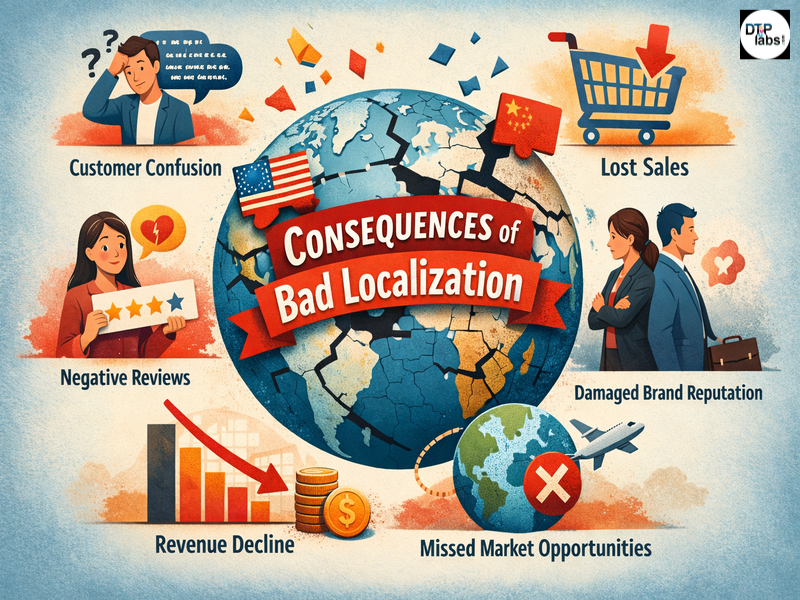
2026 localization fails in e commerce are no longer isolated incidents—they represent a systemic threat quietly draining billions from global revenue streams. As cross-border e-commerce sales push past $636 billion this year, brands that treat localization as a simple translation task are watching conversion rates collapse and legal risks escalate. From AI-generated legal disclaimers that courts now reject to checkout flows that surprise shoppers with hidden duties, these 2026 localization fails in e commerce highlight a dangerous gap between speed and substance.
One of the most alarming 2026 localization fails in e commerce involves over-reliance on unedited machine translation for critical legal and compliance content. Several large-scale retailers encountered class-action lawsuits early this year after their Terms and Conditions, translated solely by AI, were ruled legally void in EU markets. In some cases, the automated output unintentionally granted consumers stronger rights than intended, leading to multimillion-dollar settlements and immediate product recalls when safety warnings on ingredients or usage failed regulatory scrutiny. The fallout extended beyond fines: courts increasingly dismiss machine-translated evidence in trade disputes, leaving brands without defense in cross-border litigation.

Top 13 Mistakes to Avoid When Localizing Your eCommerce Store – WebToffee
A second major category of 2026 localization fails in e commerce centers on checkout and payment localization gaps. With the end of many de minimis duty-free thresholds and tightened import policies, shoppers in Asia-Pacific and Latin America frequently abandon carts when localized pages fail to clearly explain new fees or offer familiar payment methods. Non-localized sites see conversion rates as low as 1.2 percent in Asia-Pacific, compared to 4.8 percent for fully adapted experiences that include region-specific currencies, tax breakdowns, and trusted gateways like WeChat Pay or local bank transfers. Delivery surprises—packages returned due to unexplained customs charges—further amplify chargeback rates and negative reviews that tank search visibility.
Cultural and dialect mismatches form yet another critical set of 2026 localization fails in e commerce. In Middle Eastern markets, literal translations of promotional copy have clashed with religious or social sensitivities, while Latin American expansions suffer from ignoring regional Spanish and Portuguese variations that make support chatbots sound robotic or offensive. One fashion retailer saw a 40 percent drop in engagement after visuals and descriptions ignored local beauty standards and modesty preferences, allowing “local hero” competitors to capture market share by speaking authentically to shoppers.
The fourth widespread issue lies in UX and visual elements that remain unadapted. Product pages displaying imperial measurements for European buyers, date formats that confuse Asian customers, or color schemes carrying unintended meanings have driven bounce rates sky-high. When combined with robotic meta descriptions and untranslated schema markup, these 2026 localization fails in e commerce push entire international domains down in local search results, starving sites of qualified traffic before visitors even reach the homepage.
To visualize the scale of damage, consider this breakdown of common 2026 localization fails in e commerce and their measurable impacts:
| Fail Category | Typical Trigger | Regional Conversion Drop | Broader Business Cost |
|---|---|---|---|
| AI-only Legal & Safety Content | Unreviewed machine output | Up to 70% higher abandonment | Class-action suits, recalls, millions in damages |
| Checkout & Duty Disclosure | No local payment/tax adaptation | 1.2% vs 4.8% (APAC) | Chargebacks, returns, lost trust |
| Cultural & Dialect Oversights | Literal phrasing & visuals | 30-40% engagement loss | Brand mockery on social, competitor gains |
| UX & Technical Mismatches | Unadapted formats & schema | High bounce rates | Poor SEO rankings, missed opportunities |
These figures, drawn from early 2026 market analyses, underscore why 2026 localization fails in e commerce are no longer affordable experiments.
I must confess that tracking these developments stirs a genuine sense of concern within me. Watching sophisticated enterprises pour resources into market entry only to see carefully built campaigns undermined by avoidable linguistic and cultural oversights feels like a missed opportunity on a massive scale. At the same time, I feel real optimism when I see teams that pivot quickly to hybrid approaches—leveraging AI for speed while anchoring every output in human expertise. The contrast in outcomes is striking, and it reinforces my belief that thoughtful localization is ultimately an act of respect that consumers reward with loyalty.
Enterprises that want to move beyond these 2026 localization fails in e commerce must act decisively now. The following practical steps have proven effective for brands already turning the tide:
- Adopt a hybrid workflow: Use advanced AI for initial drafts and high-volume catalogs, but mandate native-speaker post-editing plus legal review for all customer-facing and compliance content.
- Conduct market-specific keyword and intent research before any translation begins, ensuring local search behavior—not English equivalents—drives content creation.
- Implement centralized terminology management and translation memory systems that propagate approved terms across every page, product, and checkout element.
- Integrate localization early in the product lifecycle, involving regional experts during design rather than as a final checkbox.
- Monitor post-launch performance with segmented analytics that track regional bounce rates, session depth, and cart completion separately, enabling rapid iteration.

Enterprise Localization Strategy in 6 Steps
By embedding these practices, organizations transform localization from a cost center into a powerful growth engine that builds genuine trust across borders. The difference between brands suffering repeated 2026 localization fails in e commerce and those thriving lies in this disciplined commitment to quality and cultural intelligence.
The window for correction is open, but narrowing. As consumer expectations rise and regulatory scrutiny intensifies, enterprises that address their localization weaknesses today will secure stronger positions in tomorrow’s global marketplace.
References:
- Taia (2026). Top 5 Localization Trends in 2026
- Ad Astra Inc. (2026). E-commerce Localization: The Complete Guide to Selling Globally 2026
- Reverie Language Technologies (January 2026). Website Localization Best Practices: 2026 Edition
- LocalizeJS (February 2026). The Ultimate Guide to Localized Marketing in 2026